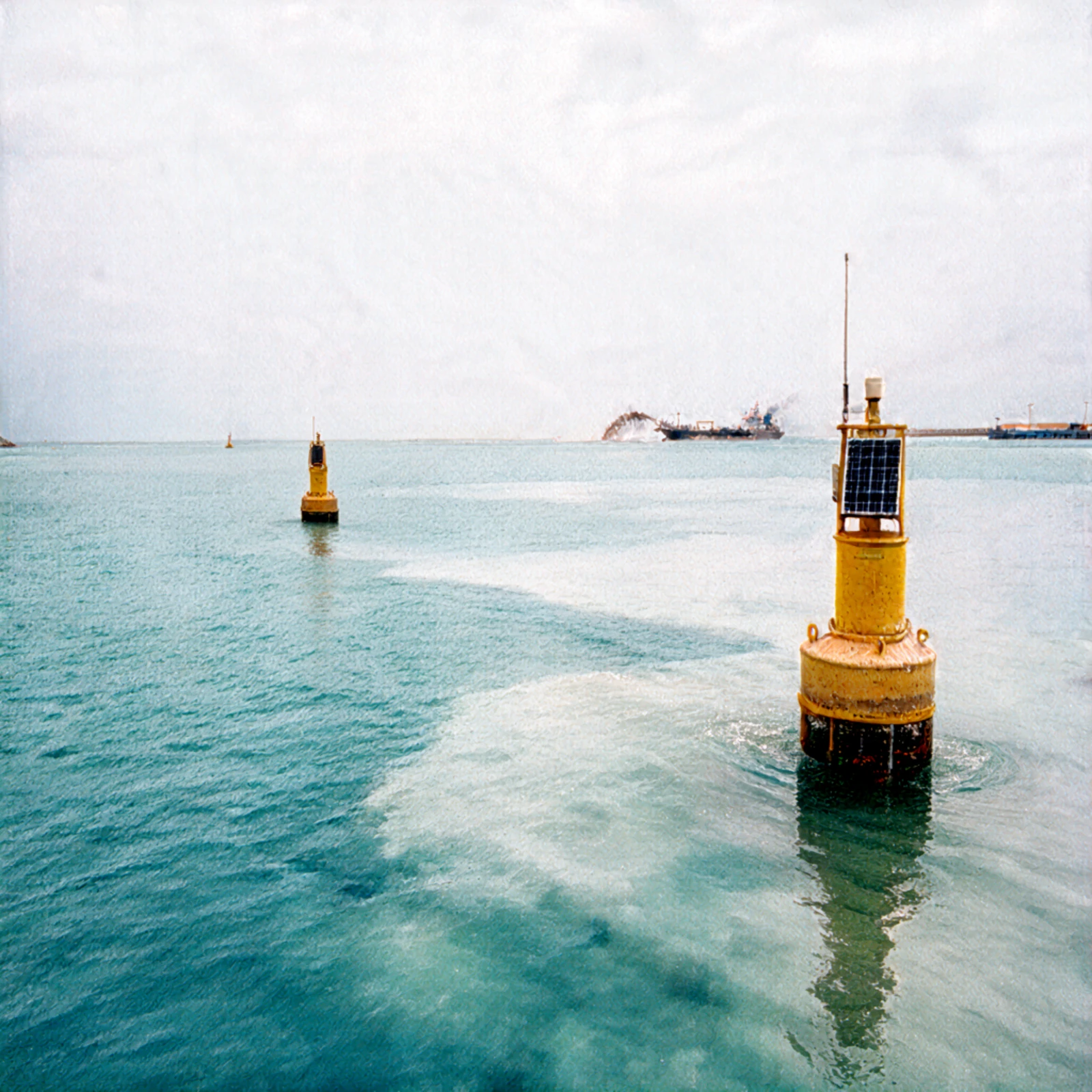
Three buoys are in the same water. Each reports a different turbidity value. In the compliance meeting, the argument is about which number is right. Before choosing one, I would put the instrument specifications and calibration records beside the readings and ask: What exactly did each instrument measure?
This is a practical comparison problem, not a reason to declare a sensor faulty. All three instruments may be functioning correctly. The word “turbidity” on a screen is not yet a complete description of the measurement behind it.
Three measurements sharing one word
NTU under US EPA Method 180.1 uses white light in the wavelength range 400–680 nm and a 90° detector. FNU under ISO 7027-1 uses infrared light at 860 nm and a 90° detector. Both optical turbidity approaches are calibrated against formazin.
Those details belong with the result. A shared calibration reference does not make the optical approaches identical, and it does not mean NTU and FNU are universally numerically interchangeable. I would check which method the instrument actually uses before comparing its output with another dataset.
Total Suspended Solids (TSS), reported in mg/L, is different again. It comes from a gravimetric laboratory measurement on a filtered sample. An optical turbidity sensor does not directly perform that measurement.
NTU, FNU and mg/L TSS can all enter a discussion about “turbidity” or suspended material. They are three different measurements, not the same quantity under different labels. Combining them in one column without their methods makes the comparison look simpler than it is.
Why the same water can give different numbers
Particle colour and size affect how particles interact with light. Different optical approaches can therefore respond differently to the material in the water. Coloured dissolved material can also affect optical response differently depending on the measurement approach. A difference between readings is not, by itself, evidence that one instrument is wrong.
The optical window matters too. Fouling can alter the measurement even when the instrument continues reporting. I would review the field maintenance and cleaning record alongside calibration and QA/QC records. Method differences and window condition are separate questions; neither should be guessed from the number alone.
If the discussion needs TSS in mg/L, the relationship to optical turbidity must be established at that site. Collect paired field turbidity measurements and laboratory TSS samples from the same site, then develop the site-specific regression. It is an empirical relationship for that water and sediment context, not a universal conversion from NTU or FNU to mg/L.
The relationship should remain traceable to the paired observations, the optical method and the instrument used. A conversion written into a display does not remove that need. Before relying on the converted result, I would ask which field measurements and laboratory samples support it.
The practical rule
Never report or compare a turbidity number without placing beside it the unit, method, sensor make/model and last calibration date. Those details let the next reviewer understand what was measured rather than infer it from a heading.
For dredging or sediment-sensitive monitoring, build the site-specific turbidity–TSS regression before dredging starts, using paired measurements and samples. Do not wait until an exceedance has occurred to work out what the optical value meant in terms of suspended solids. Establishing the relationship beforehand makes the later interpretation a comparison against documented evidence, rather than a hurried search for a conversion.
What unit does your permit actually specify, and did the sensor on the buoy measure that unit?